Indigenous Court
Provincial Court | SaskatchewanCourts of Saskatchewan
Indigenous JUSTICE INITATIVES
Provincial Court
The Provincial Court of Saskatchewan has a long history of supporting approaches that promote access to justice for Indigenous peoples throughout the province.
The Court recognizes the important role of Indigenous communities in the administration of justice and has supported processes that encourage meaningful involvement of community members while recognizing the community’s role in supporting both victims and accused persons.
Sittings in Northern and First Nations Communities
In addition to its permanent court locations, the Provincial Court regularly holds circuit court sittings in northern and First Nations communities. These sittings help ensure that residents can access court services closer to home.
The Provincial Court sits in the following communities:
• Ahtahkakoop Cree Nation
• Beardy’s & Okemasis’ Cree Nation
• Big Island Cree Nation
• Black Lake
• Buffalo River Dene Nation
• Canoe Lake Cree First Nation
• Creighton
• Cumberland House
• Deschambault Lake
• English River First Nation
• Fond du Lac
• Montreal Lake Cree Nation
• Onion Lake Cree Nation
• Pelican Narrows
• Pinehouse
• Sandy Bay
• Southend
• Stanley Mission
• Turnor Lake (Birch Narrows Dene Nation)
• Whitefish (Big River) First Nation
• Wollaston Lake
These circuit courts play a vital role in supporting access to justice by bringing court services directly to communities across northern Saskatchewan and First Nations territories.
Saskatoon Indigenous Provincial Court
In 2025, the Provincial Court began leading the development of the Saskatoon Indigenous Provincial Court (SIPC) through an Elder-guided, co-design process. This work is being undertaken in partnership with the Saskatoon Tribal Council, community service providers, victim support organizations, and justice system partners.
The goal of SPIC is to help address the overrepresentation of Indigenous people in the justice system by providing a culturally grounded, restorative, and holistic approach to justice that responds to the needs and strengths of Indigenous individuals, families, and communities.
A pilot phase is anticipated for the fall or winter of 2026.
As the development of SIPC progresses, additional information will be posted on this page.
Smudging Ceremonies
The Provincial Court recognizes the importance of Indigenous traditions and supports the use of smudging ceremonies in appropriate circumstances. Smudging is a traditional Indigenous practice involving the burning of sacred medicines to cleanse and purify the body, spirit, or place and to promote a positive state of mind for those participating in the ceremony.
Requests for smudging may be considered as part of a court proceeding or for special court ceremonies and events. The Court is committed to facilitating approved smudging ceremonies in a respectful and safe manner, consistent with applicable building and safety requirements, as part of its ongoing efforts to foster understanding, respect, and reconciliation with Indigenous peoples.
Individuals wishing to request a smudging ceremony are encouraged to review the Court’s Indigenous Smudging Ceremony Protocol for information about the application process and approval requirements.
Eagle Feathers
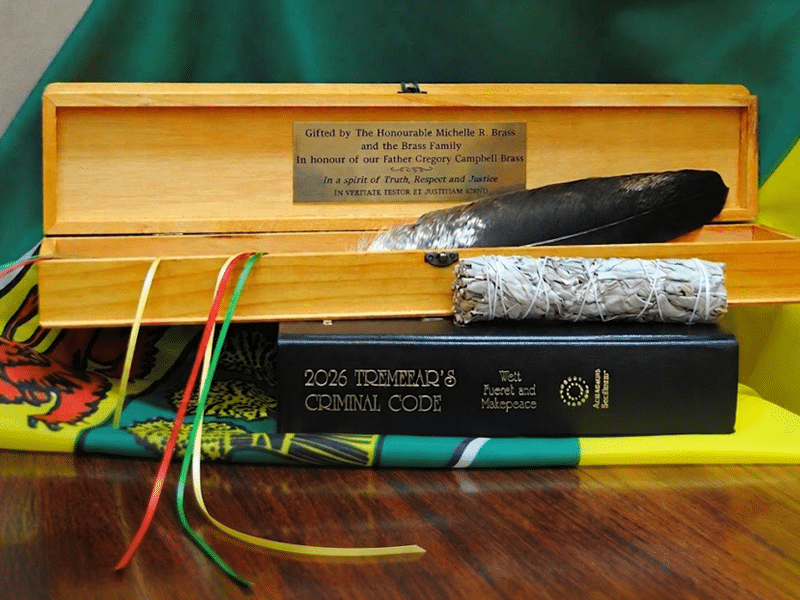
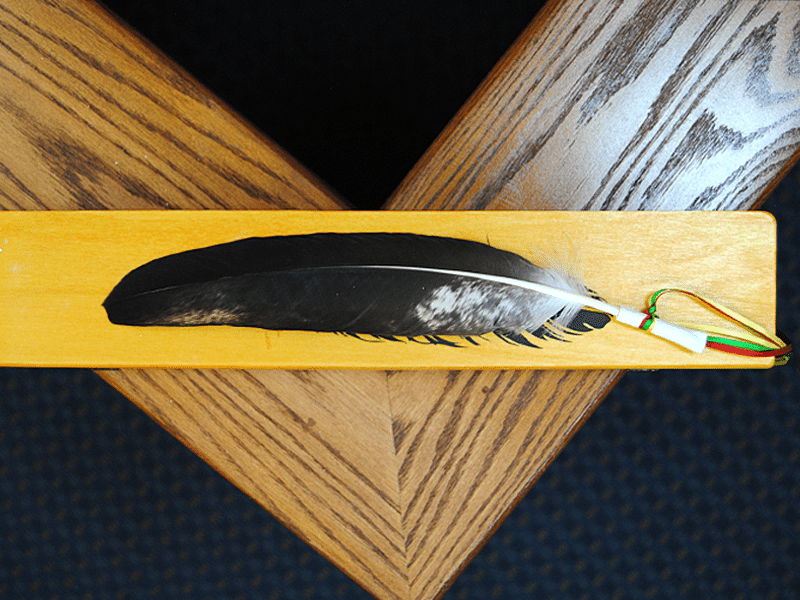
In 2026, the Court was gifted fourteen eagle feathers that can be offered to persons participating in court proceedings.
The eagle feathers will be kept at the thirteen permanent Provincial Court locations. A person who is swearing or affirming to tell the truth may hold the eagle feather or have it placed before them during the proceeding while testifying. Individuals may also bring their own eagle feather to court for this purpose.
Access to an eagle feather must be arranged in advance through the local court office. The feathers may also be made available at circuit point locations by arrangement through the court office.
The eagle feathers were gifted to the Court by Cecile Brass, sister of Provincial Court Judge Michelle Brass. Cecile Brass received the feathers from Bob Mills, former Chief of the Skidegate Band on Haida Gwaii.
Sentencing Circles and Indigenous Language Initiatives
The Provincial Court began incorporating sentencing circles into court proceedings in the early 1990s. Grounded in Indigenous traditions and values, sentencing circles focus on accountability, rehabilitation, and repairing harm through community involvement and cultural understanding.
Over time, the Court expanded the use of Indigenous languages, including Cree and Dene, in court proceedings to help make the justice system more accessible and culturally responsive.
In 2001, the Provincial Court established the Cree Court circuit, serving the communities of Pelican Narrows, Sandy Bay, Whitefish Lake First Nation, and Ahtahkakoop Cree Nation. Operating from Prince Albert, the Court team (including a judge, court clerk, Crown prosecutor, and Legal Aid defence lawyer) travelled to participating communities. The Cree Court represented an important initiative in the use of Indigenous languages and culturally responsive court processes and reflected the Court’s commitment to improving access to justice for Indigenous communities.
COURT RESOURCES
EXTERNAL RESOURCES
SOCIAL MEDIA